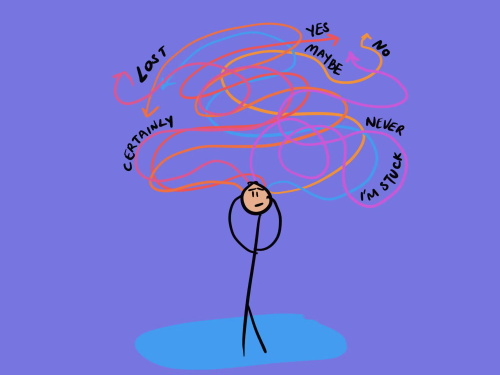

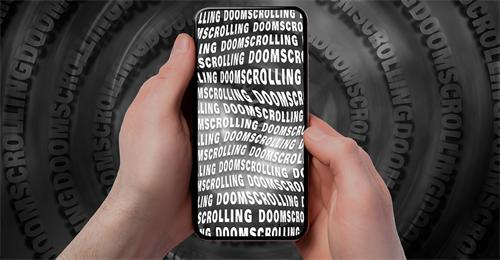
In today’s hyper-connected world, many people share a familiar experience: we know that consuming negative news makes us anxious, angry, or emotionally exhausted—yet we keep scrolling. Even more paradoxically, when we deliberately avoid bad news, we may feel a subtle sense of guilt or unease, as if we are being irresponsible, ignorant, or morally disengaged from reality.
This phenomenon is not accidental. The reason negative news can feel like a moral obligation has little to do with any actual ethical duty to monitor global suffering around the clock. Instead, it emerges from the interaction between our evolutionary brain wiring, cognitive biases, modern moral narratives, and the structural features of digital media. Together, these forces create a new kind of psychological and ethical experience unique to the information age.
1. Why the Human Brain Is Wired to Prioritize Bad News
From an evolutionary perspective, the primary function of the human brain has never been happiness—it has always been survival. Over millions of years, natural selection favored brains that detected threats quickly and remembered danger vividly.
This evolutionary legacy manifests as negativity bias: the tendency to prioritize, react more strongly to, and retain negative information more deeply than positive information. Bad news captures attention faster, provokes stronger emotional responses, and leaves more lasting impressions.
At the neurological level, the amygdala—the brain’s emotional alarm system—processes threatening information rapidly and automatically. War, violence, disasters, injustice, and crisis activate this system immediately, pushing us into a heightened state of alertness.
In ancestral environments, this mechanism increased survival odds. In modern information ecosystems, it is redirected toward news consumption. When we scroll through negative headlines, the brain creates the illusion that we are monitoring environmental risks—that we are staying vigilant. This survival-oriented reflex, once adaptive, is now subtly moralized: staying informed feels responsible; disengaging feels negligent.
2. The Psychological Trap of Unfinished Threats
Many forms of negative news share a crucial feature: they lack closure. Ongoing wars, unresolved crimes, systemic injustices, climate crises—these narratives remain perpetually open-ended.
Psychologically, such stories create what is known as an “open loop.” The human mind is deeply uncomfortable with unresolved threats and unanswered questions. We crave cognitive closure, a sense that the story has reached a conclusion.
As a result, we keep checking for updates: Has the conflict ended? Has justice been served? Has the situation improved? Yet the updates are often fragmentary, ambiguous, or simply lead to more questions. News consumption becomes a never-ending process, resembling a serialized drama without a final episode—one that continuously hijacks attention.
3. How Cognitive Biases Darken Our Perception of Reality
Humans are not passive recipients of information. Our brains actively filter and select what we consume, guided by deep-seated cognitive tendencies.
One of the most influential is confirmation bias—the tendency to seek out and accept information that confirms existing beliefs while dismissing contradictory evidence. When individuals already feel anxious or pessimistic about society, they are more likely to gravitate toward negative news that reinforces this worldview, while overlooking positive or neutral developments.
Over time, this feedback loop strengthens itself: selective exposure confirms pessimism, pessimism drives further selective exposure, and the world begins to appear overwhelmingly dangerous and broken—even if statistical reality is more nuanced.
Media structures amplify this effect. News organizations naturally favor stories with high emotional intensity, conflict, and shock value, because these capture attention. This does not mean the world is uniquely disastrous—but it does mean disaster is more visible. The brain, however, struggles to distinguish media salience from actual probability.

4. From Awareness to Virtue: How Attention Becomes Moralized
In modern societies, paying attention has increasingly been framed as a moral act. We are encouraged to believe that a good, responsible citizen should remain informed about suffering, injustice, and global crises.
This social expectation gradually becomes internalized. Not knowing—or choosing not to know—can feel like indifference or moral failure. As a result, consuming negative news transforms from a personal choice into a symbolic affirmation of ethical identity: I care, therefore I must watch.
For individuals facing distant, large-scale suffering, direct action often feels impossible. In such cases, continuous attention, sharing, and commentary offer a form of moral compensation. These actions create a sense of “being present” and “not remaining silent,” even when tangible impact is minimal. Attention becomes a substitute for agency.
5. Why Moral Discomfort Can Feel Virtuous
Negative news evokes emotions such as compassion, outrage, guilt, and moral anger—emotions deeply tied to ethical evaluation. Although uncomfortable, these feelings confirm that our moral sensibilities are intact.
At a subconscious level, painful awareness can acquire a sense of superiority over comfort or joy. Suffering alongside the world feels more serious, more responsible, more enlightened than focusing on personal well-being. This belief—better to be painfully awake than happily ignorant—can turn emotional distress into a marker of moral worth.
Within certain online communities, staying updated on specific crises becomes a form of moral credentialing. Awareness functions as social currency. Failing to keep up risks exclusion, criticism, or accusations of apathy. Attention thus becomes not only ethical but social—a requirement for belonging.
6. Algorithmic Amplification and the Illusion of Duty
Digital platforms intensify these dynamics through algorithmic feedback. The more we engage with negative content, the more systems interpret it as a core interest, delivering an increasing volume of similar material.
Over time, this creates a powerful illusion: everything is collapsing, and I must remain vigilant. The constant stream of crisis reinforces urgency, making disengagement feel irresponsible.
When meaningful action—donating, voting, organizing—feels inaccessible or uncertain, the brain may mistakenly treat information consumption as action itself. Paying attention becomes psychologically equivalent to contributing. This misattribution reduces the internal pressure to act, while maintaining a sense of moral participation.
7. When Moral Vigilance Turns Into Emotional Depletion
The cost of this dynamic is significant. Continuous exposure to suffering drains emotional resources, often leading to compassion fatigue. People may continue consuming negative news, but without genuine empathy—replaced instead by numbness, cynicism, or despair.
Excessive focus on negative narratives also distorts risk perception, fostering the belief that danger is omnipresent. This contributes to chronic anxiety and disengagement from everyday life, relationships, and personal well-being.
Ironically, a practice rooted in moral concern can end by undermining the very capacities—empathy, resilience, agency—that ethical action requires.
8. Rebuilding a Healthier Ethics of Attention
Understanding why negative news exerts such moral pull is not an argument for indifference. Care and awareness remain essential. The challenge is cultivating a sustainable ethics of attention.
Setting intentional boundaries—limiting time spent on news, choosing specific moments for engagement—helps prevent emotional overload. Attention should serve understanding and action, not endless immersion in distress.
Rather than passively absorbing algorithm-driven content, individuals can consciously select a small number of issues to follow deeply, prioritizing sources that include context, solutions, and signs of progress. Exposure to constructive or solutions-oriented journalism helps the brain develop a more balanced map of reality.
Conclusion: Building a Vessel in the Information Flood
The sense of moral obligation associated with consuming negative news arises from a convergence of human empathy, social expectations, and digital design. It reflects how morality in the information age is shaped not only by what we do, but by what we attend to—and how.
True ethical responsibility does not require drowning in information. It requires discernment. Rather than surrendering to the current, we can learn to navigate it deliberately—transforming emotional energy into understanding, and understanding into meaningful action.
In an era of endless information, morality is no longer about constant vigilance, but about building a vessel capable of steering through the flood.
References
- Baumeister, Roy F., et al. “Bad Is Stronger Than Good.” Review of General Psychology, vol. 5, no. 4, 2001, pp. 323–370.
- Pariser, Eli. The Filter Bubble: What the Internet Is Hiding from You. Penguin Press, 2011.
- Rozin, Paul, and Edward B. Royzman. “Negativity Bias, Negativity Dominance, and Contagion.” Personality and Social Psychology Review, vol. 5, no. 4, 2001, pp. 296–320.
- Cinelli, Matteo, et al. “The Echo Chamber Effect on Social Media.” Proceedings of the National Academy of Sciences, vol. 118, no. 9, 2021, e2023301118.