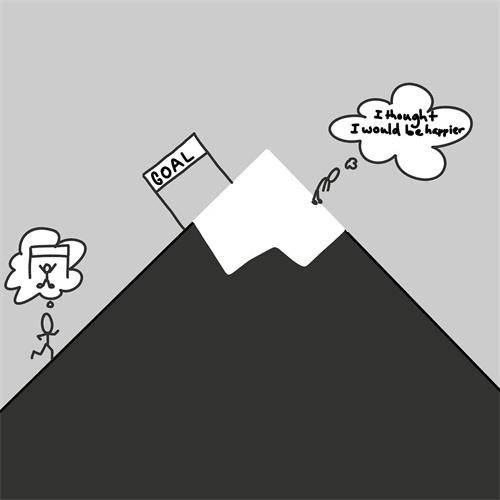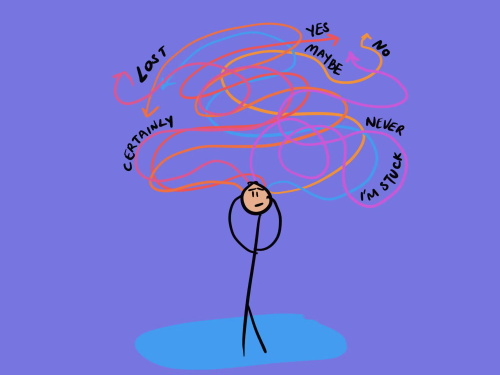
Many people have experienced this paradox:
We know that a certain outcome may be painful or even damaging, yet we still feel an overwhelming urge to reach a conclusion.
An unresolved relationship, an answer that never arrives, a decision endlessly postponed—none of these situations are actively harming us in the present, yet they drain our energy, attention, and emotional capacity. Eventually, we may even choose a clearly negative outcome simply to end the waiting.
Why does a bad result sometimes feel preferable to no result at all?
The answer is not that humans are irrational. It lies in a deep psychological drive: our innate obsession with completion.
1. The Human Need for Wholeness: The Burden of Unfinished Events
Gestalt psychology emphasizes that human beings naturally seek closure and completeness. According to Frederick Perls, one of its founders, many persistent psychological struggles originate from experiences that were never fully processed or completed—what he referred to as unfinished business.
An unresolved situation does not quietly fade into memory. Instead, it forms an “open cognitive loop.” Like a background application running continuously, it occupies mental bandwidth, repeatedly pulling our attention back to itself. We replay scenarios, imagine possible outcomes, and rehearse conversations that never happen.
On a neurological level, uncertainty itself is perceived as a threat. The brain’s threat-detection system—particularly the amygdala—remains activated when outcomes are unclear. Even in the absence of immediate danger, the body stays on alert. Stress hormones such as cortisol remain elevated, increasing anxiety, impairing sleep, and gradually degrading decision-making capacity.
From the brain’s perspective, a definitive outcome—even a negative one—can switch off this alarm.
From an evolutionary standpoint, a known danger is always easier to manage than an unknown one.
2. Why Harmful Outcomes Feel More Tolerable Than Ambiguity
Psychological research consistently shows that humans are not merely pleasure-seeking; we are uncertainty-averse.
Daniel Kahneman’s peak–end rule suggests that our memory of an experience is shaped not by its overall duration or average quality, but by two moments: its emotional peak and its ending. In other words, an experience without an ending resists being mentally “filed away.”
A bad ending, though painful, still provides structure. It allows grief, anger, disappointment, and acceptance to have a clear target. It gives the psyche permission to begin healing. Endless waiting, by contrast, traps suffering in the present tense—never resolved, never archived.
This is why people persist in finishing experiences they rationally know will bring little reward: completing a frustrating book, pushing through a demoralizing game, or forcing a failing relationship to its breaking point. The relief of completion can temporarily outweigh rational evaluations of value.
Closure offers emotional release—even when the content of that closure hurts.

3. The Seduction of Certainty and Cognitive Closure
The Zeigarnik Effect demonstrates that unfinished tasks are remembered more vividly than completed ones. They repeatedly intrude into consciousness, creating psychological tension. That tension motivates action—not necessarily wise action, but any action that promises resolution.
When the need for certainty becomes intense, people may accept simplistic, distorted, or even harmful explanations just to achieve closure. The relief that follows feels like clarity, but it is often merely the absence of tension.
In moments of loss of control, choosing a known harmful outcome can also restore a sense of agency:
“At least this was my decision.”
Sunk cost bias further complicates matters. Once we have invested significant time, emotion, or resources, abandoning the situation feels like admitting waste. To avoid this loss, we chase a final result that might “justify” the investment—even if it deepens the damage.
4. When the Desire for Closure Becomes a Psychological Trap
The drive for completion becomes dangerous when it turns compulsive.
People may rush into suboptimal or harmful decisions simply to escape uncertainty. They may become attached to symbolic completion—finishing a task for its own sake—while ignoring its real cost. Some even provoke crises or conflicts intentionally, believing that “a dramatic ending is better than endless doubt.”
But closure does not equal resolution.
Ending anxiety does not guarantee long-term well-being.
An even subtler danger lies in rejecting the process itself. When individuals fixate solely on outcomes, they often invalidate the emotional experience of the present. This rejection erodes intrinsic motivation and replaces growth with anxious calculation. Over time, people punish themselves with imagined futures rather than engaging meaningfully with the present moment.
5. Is Regret Inevitable After a Bad Outcome?
Almost inevitably—but the depth of regret depends on the psychological state in which the decision was made.
Psychology distinguishes between two types of regret:
> Action regret: “If only I hadn’t done that.”
> Inaction regret: “If only I had acted.”
Research suggests that, over time, inaction regret tends to linger longer. Unchosen paths preserve infinite hypothetical possibilities, whereas action produces a concrete reality.
The most destructive regret arises when outcome regret and process regret overlap. The pain is no longer just about what happened, but how it happened.
For example, a person may not regret ending a relationship—but regret the impulsive, cruel, or fear-driven way they did it. When a bad outcome is paired with a process that violates one’s values, regret strikes at identity itself.
This is where regret becomes existential rather than situational.
6. Learning to Coexist with the Unfinished
Not everything needs immediate closure. Some experiences gain meaning precisely through their openness.
Maturity is not the ability to force conclusions, but the capacity to tolerate ambiguity without self-betrayal.
Practical strategies include:
> Creating intentional waiting periods for major decisions, transforming passive delay into purposeful observation.
> Reframing sunk costs as tuition, not debt—lessons paid for, not obligations owed.
> Asking a critical question before acting: Am I solving a problem, or merely silencing discomfort?
When a bad outcome does occur, avoid collapsing into self-condemnation. Instead, conduct a calm post-analysis:
What has this outcome taught me about reality, about others, about myself?
In doing so, failure becomes cognitive capital rather than pure loss.
Conclusion
We crave results not because outcomes matter more than experiences, but because the human mind struggles to live with the unresolved.
Yet freedom does not come from forcing closure at any cost—it comes from developing the strength to remain present within uncertainty.
Accept that decisions are sometimes made with incomplete information. Accept that bad outcomes and regret are part of being human. But do not allow regret to define you—allow it to instruct you.
Some unfinished things are not flaws.
They are evidence that life is still unfolding.
References
- Kahneman, Daniel, Barbara L. Fredrickson, Charles A. Schreiber, and Donald A. Redelmeier. “When More Pain Is Preferred to Less: Adding a Better End.” Psychological Science, vol. 4, no. 6, 1993, pp. 401–405.
- Tversky, Amos, and Daniel Kahneman. “Judgment under Uncertainty: Heuristics and Biases.” Science, vol. 185, no. 4157, 1974, pp. 1124–1131.
- Zeigarnik, Bluma. “On Finished and Unfinished Tasks.” Psychologische Forschung, vol. 9, no. 1, 1927, pp. 1–85.